

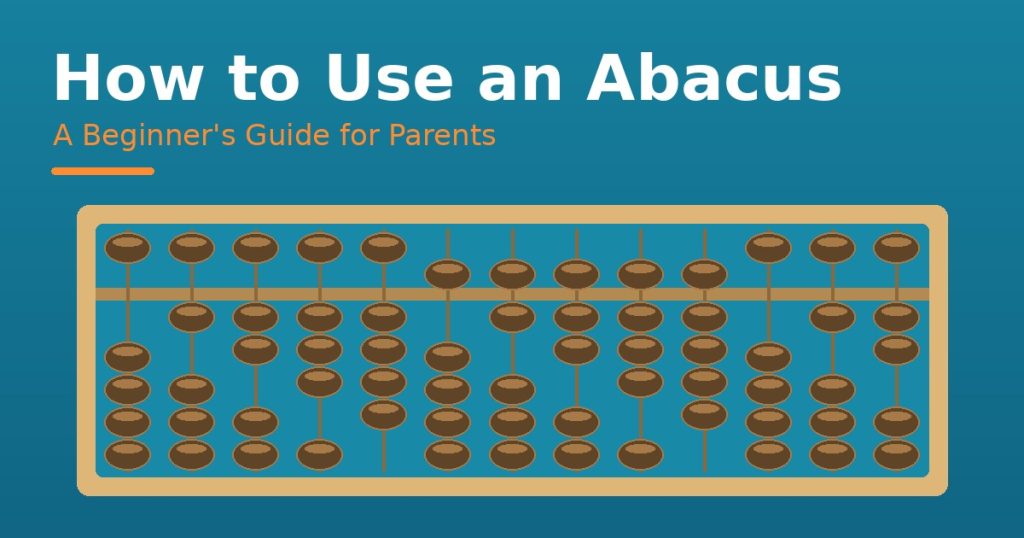
If you have ever looked at an abacus and wondered how anyone does math on it, you are not alone. It looks like a counting frame with beads — and that is exactly what it is. But in the right hands, those beads become a calculator, a memory tool, and a way for a child to do math in their head.
We have taught abacus since 2008, to thousands of students — including our own two children. This guide shows you how an abacus works, how to read a number on it, and how to do your first addition and subtraction with your child. No math degree required.
What is an abacus?
An abacus is a counting tool made of rods and beads, set in a frame. The kind we use is the Japanese soroban: a wide, flat rectangle, much wider than it is tall, with a bar running across it about a quarter of the way down.
Each rod is one place value — ones, tens, hundreds, and so on — just like the columns in a written number. The beads on a rod show the digit in that column.
You do not need a fancy abacus to start. Any standard soroban works, and the one in our program is the same kind children have used for generations.
The parts of an abacus
Before you calculate anything, learn the parts:
- The frame — the wooden rectangle that holds everything together.
- The rods — vertical rods running top to bottom. Each rod is one digit.
- The bar — the horizontal bar across the middle. Beads only count when they touch the bar.
- The upper bead — one bead above the bar on each rod. It is worth 5.
- The lower beads — four beads below the bar on each rod. Each one is worth 1.
- The bottom bar — the base of the frame. Lower beads rest on it when they are not in use.
When you start, push all the upper beads up (away from the bar) and all the lower beads down (away from the bar). That is zero. Nothing is touching the bar, so the abacus reads 0 (zero).
How to read a number on an abacus
A bead counts only when it touches the bar. That is the one rule that makes everything else work.
- Push one lower bead up to the bar: that rod reads 1.
- Push two lower beads up: 2. Three: 3. Four: 4.
- Push the upper bead down to the bar: 5.
- Upper bead down plus one lower bead up: 6. Plus two: 7. Plus three: 8. Plus four: 9.
So a single rod can show any digit from 0 to 9 — exactly one digit, just like one column of a written number.
Now read across the rods. The rod on the far right is the ones. The next rod to the left is the tens. The next is the hundreds. Read the rods left to right, and you have the number.
For example, if the tens rod shows 2 and the ones rod shows 3, the abacus reads 23. If the hundreds rod shows 1, the tens rod shows 0, and the ones rod shows 4, it reads 104.
Try it with your child: set a number on the abacus, and ask them to read it out loud. Then say a number and ask them to set it. That back-and-forth is the fastest way to learn the beads.
How to set a number: step by step
- Clear the abacus. Push all upper beads up and all lower beads down. Every rod reads 0.
- Start from the left. Find the leftmost rod you need — the highest place value in your number.
- Set each digit. For each rod, move the beads that add up to that digit: upper bead down for 5, lower beads up for 1 each.
- Read it back. Check the number by reading the rods left to right.
Example: set 47.
- Tens rod: 4 — push four lower beads up.
- Ones rod: 7 — push the upper bead down (5) and two lower beads up (2).
- Read it back: 47.
Your first calculation: simple addition
Addition on an abacus is just setting the first number, then adding the second number to it, rod by rod, starting from the right.
Try 23 + 17:
- Set 23 on the abacus — tens rod 2, ones rod 3.
- Add 17. Start with the ones: add 7 to the ones rod. The ones rod already shows 3. Add 4 lower beads? There is only 1 lower bead left before the rod fills — so use the complement: 3 + 7 = 10, which means clear the ones rod to 0 and carry 1 to the tens rod.
- Now the tens rod: it shows 2, plus the carried 1 makes 3, plus the 1 from 17 makes 4.
- Read the abacus: 40.
That carry — the moment a rod fills up and you move one to the next rod — is the heart of abacus math. Children learn it by feel, with the beads, long before they learn it as a written rule. That is why it sticks.
Do not worry if the first few tries feel slow. Speed comes from practice, and the understanding comes first.
Your first subtraction
Subtraction works the same way, in reverse: set the first number, then take the second number away, rod by rod.
Try 40 − 13:
- Set 40 — tens rod 4, ones rod 0.
- Subtract 13. Start with the ones: take 3 from the ones rod. It shows 0, so borrow 1 from the tens rod — the tens rod goes from 4 to 3, and the ones rod gets 10. Take 3 away from 10, leaving 7.
- Now the tens rod: it shows 3, take 1 away, leaving 2.
- Read the abacus: 27.
Again, the borrowing happens with the beads, where your child can see it and feel it. That is the point: the abacus makes the abstract visible.
How to practice with your child
Short and regular beats long and rare. Here is what works for most families:
- 5 to 10 minutes a day is enough to start. A few minutes, a few times a week, with a short lesson once a week.
- Start with reading numbers. Before any addition, make sure your child can set and read any number up to 99.
- Use real things. Count apples, steps, or toy cars on the abacus. Math that connects to real life is math that sticks.
- Let them teach you. Once your child can do a calculation, ask them to show you how. Teaching it back is the best test of understanding.
- Celebrate the small wins. The first time your child adds two numbers without paper is a real moment. Notice it.
If you want a plan to follow, our program lays it out week by week — six units, 11 weeks each, from reading numbers to calculating in your head. See the full curriculum or start here to see how the lessons work.
Common mistakes to avoid
- Counting beads that are not touching the bar. Only beads touching the bar count. A bead halfway up a rod is worth nothing — push it all the way to the bar or all the way away.
- Starting from the wrong side. Set numbers from the left (highest place value first), but add and subtract from the right (ones first), just like written math.
- Forgetting to clear the abacus. Always start a new calculation from zero. Leftover beads from the last sum are the most common cause of a wrong answer.
- Rushing to speed. Speed is the result of practice, not the goal of the first week. Accuracy first, speed later — the speed comes on its own.
- Practicing in long sessions. A tired child stops learning. Stop while it is still fun, and come back tomorrow.
Frequently asked questions
What kind of abacus should I buy?
A standard Japanese soroban — one bead above the bar and four below on each rod. That is the kind our program uses, and it is the most widely available. A 13-rod or 15-rod abacus is a good size for a child.
How old should my child be to start using an abacus?
Most children can start at 4 or 5, once they can read and write numbers 0 to 99. See our age guide for the full picture, including readiness signs and what to do if your child is 3 or 10.
Do I need to know abacus myself to teach my child?
No. You need to stay one lesson ahead, and the video tutorials show you exactly what to teach. Most parents feel comfortable after four to six weeks. See our guide to teaching abacus at home.
How long does it take to learn the abacus?
Most children can read numbers and do simple addition within a few weeks of steady practice. Calculating in their head — mental math without the abacus — usually starts within a few weeks too, and the full curriculum takes about 18–24 months.
Is the abacus still useful with calculators around?
Yes. Calculators give answers; they do not build the number sense that lets a child understand what an answer means, check whether it is reasonable, or work without a device. The abacus builds that number sense — and the mental math that comes with it.
Start here
The best way to learn the abacus is to use one. Set a number. Add two numbers. Make a mistake, clear it, and try again. That is how every abacus student has learned, for centuries.
If you want to try it with your child, start with the free first four weeks — watch the first lessons, do the worksheets together, and see if it fits your family. Try free for 7 days at learnabacusathome.com.